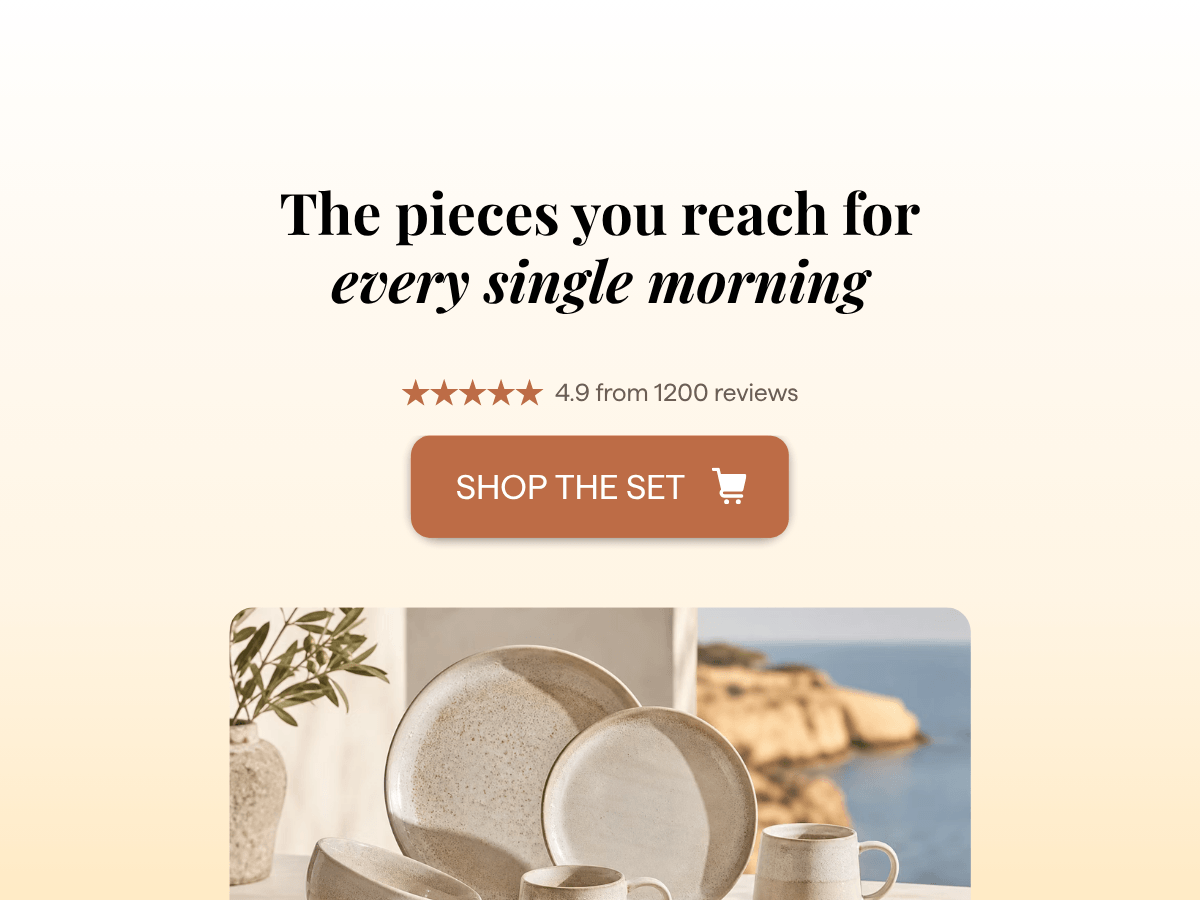
Template Overview
The DTC landing page template is a single-product storefront that does more than show a product. It walks visitors through the brand story, the founder, the studio, the materials, and the reviews, then takes the shipping address and charges the card on the next page. The whole purchase happens inside one funnel, on one URL, without a separate Shopify checkout.
The template is built for small-batch brands where every customer matters. Pottery studios, candle makers, coffee roasters, skincare lines, ceramics, leather goods, slow-fashion labels. The kind of product where the story is the reason someone buys, and where a generic product page leaves money on the table. Use it to launch a new product, run a paid traffic campaign, or replace a homepage for a single hero SKU.
Every section is editable. Swap the photos, rewrite the founder story, change the price, point the payment block at your Stripe or PayPal account, and publish. The shipping form, the discount calculator, and the payment block come pre-wired so the buyer goes from "shop the set" to "thanks for ordering" in three pages.
Key Features
Built-in payment collection. The final page takes payment through Stripe or PayPal in EUR, USD, GBP, or any currency you set. Card, PayPal, EPS, iDEAL, and SEPA Direct Debit all run through the same payment block.
Discount calculator. A formula field reads the newsletter-opt-in checkbox and applies a discount before the buyer hits the payment block. Newsletter check = 5% off. No check = full price. Change the percentage in one place.
Storytelling sections that scroll. Hero, press logos, testimonial quote, founder story, studio photo, three-step process explainer, materials cards, and a final closing CTA. All vertical, all editable, all swappable.
Shipping address form. The contact form collects first name, last name, email, phone, street address, city, and country before payment so you can fulfill on the spot. Required fields are enforced.
FAQ accordion. A pre-built FAQ block answers the questions that keep buyers from clicking buy. Dishwasher safety, production time, replacement parts, international shipping, color variation. Edit the questions to match what your support inbox actually gets.
Benefits
Customers buy on the same page they discover you on, so traffic does not bleed out to a separate checkout that loses 20-30% of intent.
The brand story sits in front of the buy button, so visitors who land cold from a paid ad get the founder, the studio, and the process before they get the price.
The discount calculator turns newsletter signups into orders. The 5% off is conditional on a checkbox, so non-subscribers pay full price and subscribers feel rewarded.
The shipping form blocks junk submissions because address and email fields are required, so the orders that hit your backend are real orders with real shipping data.
The payment block charges the card the second the buyer clicks pay. No Stripe checkout redirect, no abandoned cart on a third-party domain, no extra step where Apple Pay loads slowly and the buyer walks away.
Frequently Asked Questions
-
A direct-to-consumer landing page is a single-product page that sells without sending the buyer to a separate ecommerce site. It carries the brand story, the social proof, the product details, and the checkout in one continuous flow. Used by indie brands, small-batch makers, and any seller where the story is the reason the product is worth more than a commodity equivalent.
-
No. The template is a full standalone landing page with payment collection built in. You point the payment block at your Stripe, PayPal, or Square account and the funnel handles the order. If you already have Shopify, you can still use the funnel as an ad landing page and pass the order to Shopify through Zapier or webhooks.
-
Stripe, PayPal, and Square. Stripe alone handles cards, EPS, iDEAL, and SEPA Direct Debit. PayPal handles PayPal. Square handles cards. You connect your own account in settings and funds land in your bank, not in involve.me.
-
Yes. The payment block has a currency dropdown. EUR, USD, GBP, AUD, CAD, and most other currencies your payment provider supports are available. Set it once in the payment block and the calculator field updates to match.
-
The newsletter checkbox on the shipping page is wired to a calculator formula. If the buyer checks the box, the formula multiplies the price by 0.95 and the payment block charges the discounted amount. If the buyer leaves it unchecked, the full price stays. Change the percentage by editing one formula.
-
The template is built for a single hero product, which is the configuration that converts best for DTC. If you want to offer variants or bundles, duplicate the funnel per product or add a question step that branches the buyer to the right outcome page. Score-based or Answer-based outcomes can route different buyers to different product configurations.
-
Yes. Every section stacks vertically and adapts to phone screens. The hero, the founder story, the process cards, the testimonials, the FAQ, and the payment block all reflow for narrow viewports. Mobile is the default for most DTC paid traffic, so the template is tested there first.
-
A/B testing is built in with involve.me. Change the headline, the hero image, the price, or the founder story, and the platform splits traffic between 2 versions automatically. Per-variant conversion rate shows up in the same analytics dashboard, so you do not need an external split tester.
-
The shipping form is a contact form component pre-configured with first name, last name, email, phone, street address, city, and country. Required fields are enforced before the buyer can advance to payment. Add or remove fields by editing the contact form in the funnel editor.
-
The buyer sees a thank you message, and the order data, shipping address, and payment confirmation are stored in the funnel submission. From there, the order can route to your fulfillment tool, your CRM, or your accounting tool through native integrations or through Zapier and webhooks. Built-in email automation sends the receipt and shipping notification without a separate ESP.
-
Yes. Built-in email automation is part of the platform. Trigger a receipt email on payment, a shipping notification when the order is fulfilled, a check-in email two weeks later, and a reorder reminder at the right interval. Sequences run inside involve.me without a Mailchimp, Klaviyo, or ConvertKit handoff, though those tools connect natively if you already use one.
-
The template includes a required consent checkbox for personal data processing before the buyer can submit. involve.me is SOC 2 Type II certified and GDPR-compliant, and data is hosted in EU data centers. You provide the privacy policy URL and the popup text. Newsletter opt-in is a separate checkbox so consent is recorded explicitly for each purpose.
-
It depends on the level of customization you need, but you can customize and publish a working version in under an hour. Open the template, swap the product images, rewrite the headline and founder story, connect your Stripe or PayPal account, and click publish. The first paying order can land the same day the page goes live.


